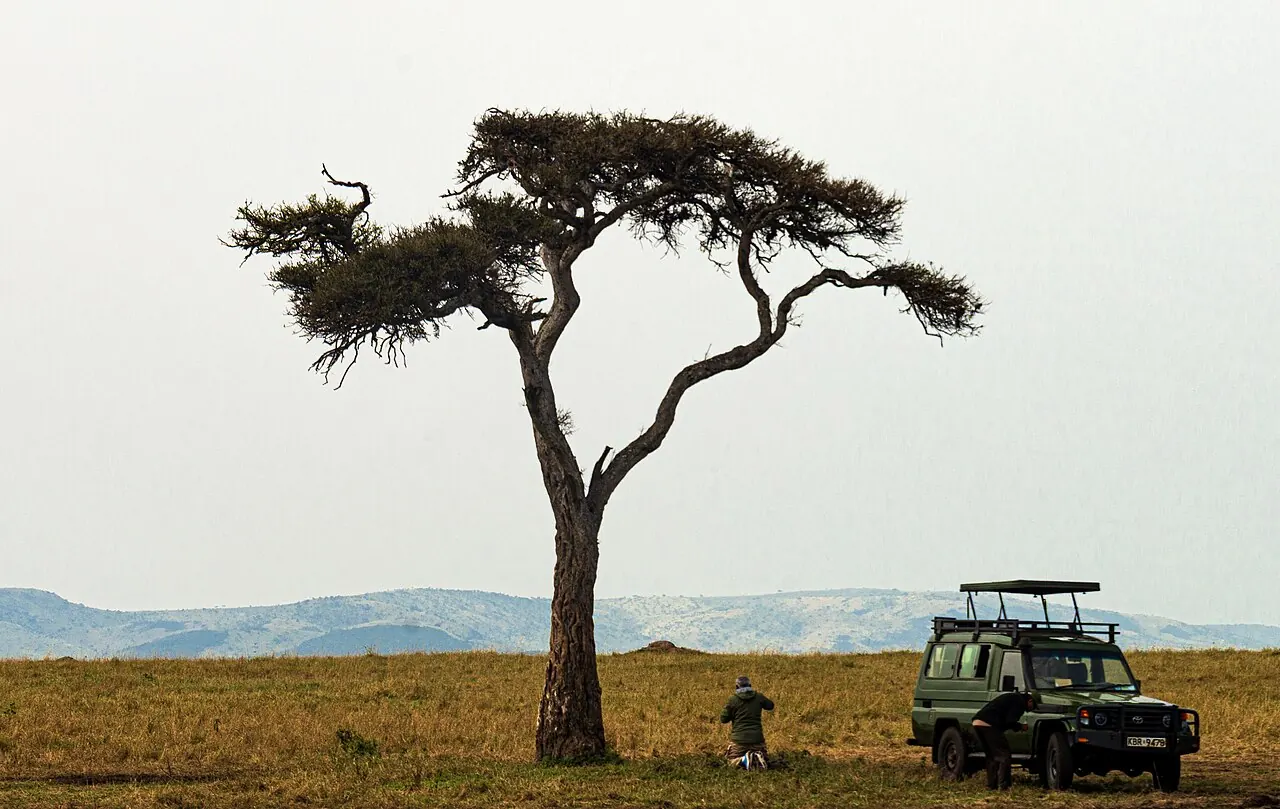

What is a Mara wildlife conservancy?
An area of privately owned Maasai land outside the Masai Mara National Reserve that landowners lease, as a block, to tourism partners for conservation. In return for monthly lease payments the owners accept limits on settlement, grazing, fencing, farming and land sales for the length of the lease.1
MMWCA describes it simply: tourism partners pay landowners a guaranteed fee per acre every month for the right to run a limited number of camps, ideally at about one visitor per 350 acres, with strict limits on vehicles at sightings2. In 2026 it counted more than 17,000 landowners and 52 tourism partners, paying over US$7 million a year in leases3.
- Land is titledGroup ranches around the Reserve were subdivided into individual plots, mostly from the late 1990s to 200941.
- Owners pool their plotsNeighbouring landowners join one conservancy and sign leases, usually through a landowner company or trust.
- Partners pay rentCamps and operators pay a fixed rent per acre or hectare, monthly, into landowners’ bank accounts, whatever the number of tourists56.
- Rules keep it wildBed caps, vehicle limits and grazing plans keep the land open and quiet; rangers enforce them.
- Wildlife pays the billsVisitors come for wildlife that moves freely between the conservancy and the Reserve; their fees fund the leases.
How did the Mara conservancies begin?
Out of the subdivision of the group ranches. Once families held individual titles, the risk was that each plot would be fenced or farmed; leasing the plots back together as conservancies, from the mid-2000s, gave owners an income for keeping them open.
From the 1970s to the mid-1980s communal trust land became group ranches; from the 1980s these were subdivided among members with private titles4. Koiyaki, the ranch that became much of today’s eastern conservancies, was divided in at least three rounds over 25 years, finishing in 20091. Only adult men on the registers received land, and around 300 of about 800 households were left out1.
The first Olare Orok leases in 2006 paid KES 2,500 per hectare a year, about US$33, straight to households regardless of tourist numbers5. Naboisho started with 15-year leases in 2010, and others followed1. In 2019 the conservancies renewed most leases for 25 years3.
- 1980Ol Chorro Oiroua Roberts family home built in the area while doing conservation work; it later became Richard's Camp.
- 1991Ol Chorro Oiroua Founded as a Wildlife Trust by community elders.
- 1992Ol Chorro Oiroua Two white rhinos borrowed from Solio Ranch.
- 1993Ol Chorro Oiroua Ten southern white rhinos translocated from KwaZulu-Natal.
- 1994Mara Lemek Olchorro Oiroua court ruling on gate fees prompts Koyiaki and Lemek members to press for their own wildlife trust.
- 1994Ol Chorro Oiroua Court ruling lets landowners collect gate fees from visitors on their land.
- 1995Mara Lemek Koiyaki Lemek Community Wildlife Trust established on 15 September 1995.
- 1995Olderkesi c. mid-1990s: Cottar's 1920s Camp operating in Olderkesi since the mid-1990s (IUCN).
- 1996Mt. Suswa CHRD says Mount Suswa has been under local Maasai care through the Suswa Conservancy Trust 'since 1996'.
- 1999Mara Lemek Lemek Group Ranch completes subdivision.
- 1999Olarro North Maji Moto group ranch begins subdivision; 72 of 2,317 parcels later allocated to Olarro North (Kirigia & Riamit).
- 2000Mara Naboisho Before 2000 the area was part of the Koiyaki-Lemek Group Ranch, under growing pressure from subdivision and land degradation (conservancy history).
- 2000Ol Chorro Oiroua Richard and Liz Roberts open Richard's Camp in the former homestead.
- 2001Pardamat A land-use zoning map sets Pardamat aside as a settlement area (TNC).
- 2004Mara Siana MMWCA: Siana Conservancy originally established.
- 2004Nyekweri Kimintet Formed and registered as a CBO.
- 2005Mara Ripoi 'Est. 2005' (own About page).
- 2005Mt. Suswa A Suswa tourism site says the conservancy has offered visits 'since 2005'.
- 2005Ol Kinyei Conservancy established with about 5,000 acres on a 5-year lease (IUCN), or 8,000 acres (Porini), through Gamewatchers/Porini.
- 2006Olare Motorogi Olare Orok Conservancy formed in May with 277 Maasai landowners (MMWCA gives 2007).
- 2006Oloisukut Founded (Facebook page).
- 2007Isaaten Mara Bushtops opens on the site of the former Cottars Mara Camp and begins working with local landowners.
- 2007Mara Lemek Losokwan Camp built within the Lemek area.
- 2007Olare Motorogi Motorogi Conservancy established as an extension of Olare Orok, with support from Sir Richard Branson / Virgin.
- 2008Mara North Founding tourism members approach Maasai leaders; 750 landowners agree to lease land.
- 2008Mara Siana Entumoto Safari Camp being built; Siana demarcation committee planning to subdivide the Sekenani valley; Entumoto proposes leasing it for conservation.
- 2008Mt. Suswa Started as Mount Suswa Conservation Trust (MMWCA).
- 2009Enonkishu Founding meeting under a tree on the edge of Kileleoni Hill.
- 2009Mara Lemek Lemek Conservancy registered after breaking from the trust.
- 2009Mara Naboisho The last area of Koiyaki was subdivided and allocated in late 2009, after delays from a court case and irregular allocations.
- 2009Mara North Conservancy officially established on 1 January 2009.
- 2009Olare Motorogi Olare Orok & Motorogi Trust set up.
- 2010Mara Naboisho Lease agreement finalised in March; about 500 landowners sign; first tourism operations begin.
- 2010Olderkesi Olderkesi Group Ranch adjudicated; formal subdivision discussions begin (IUCN; Kirigia).
- 2010Oloisukut Started operation (Facebook page).
- 2011Enonkishu No cultivation on Enonkishu land from 2011 onward.
- 2011Mara Naboisho Basecamp Explorer Foundation Kenya facilitates an 'Ecological Brainstorming'; MMWCA says its best practices were implemented in Naboisho.
- 2011Mara North High Court ruling in the Mutaka Ole Mpooya land-use petition against MNC.
- 2011Mara Ripoi Olarro Conservancy created on the outer edge of the reserve (Mara Siana Camp).
- 2011Olarro North Olarro Conservancy created (Mara Siana Camp).
- 2012Enonkishu Wood family begins converting the cultivated Olerai Farm into Naretoi.
- 2012Maasai Moran Maasai conservationists at Oloirien Group Ranch begin advocating a community conservancy.
- 2012Olare Motorogi Olare Orok and Motorogi combined to form Olare Motorogi Conservancy.
- 2012Olarro North Olarro Lodge opens (eco-rating profile).
- 2013Enonkishu Collective herd formed; AECF grant secured (2013-14, conservancy account).
- 2013Isaaten Watson map records Isaaten's boundaries as not yet finalised.
- 2013Mara Naboisho Naboisho becomes the first wildlife conservancy in the Global Sustainable Tourism Council Early Adopter Program.
- 2013Olare Motorogi Tony Lapham Mara Predator Hub launched in the conservancy (November). MMWCA founded the same month with eight member conservancies.
- 2013Olderkesi January: CWCT, OCWT and the Group Ranch Committee agree to restrict grazing in the core area; landowners' trust initiated.
- 2014Enonkishu Mara Training Centre built.
- 2014Maasai Moran Community-based giraffe monitoring begins at OGR.
- 2014Mara Siana 31 March: first section of Mara Siana Conservancy (initially Entumoto Conservancy) formed when landowners signed lease intent under a tree in the Sekenani Valley.
- 2014Olare Motorogi MPCP annual lion surveys begin; Olare Motorogi has the highest lion density in the first survey.
- 2014Pardamat Fencing becomes widespread around this year (BCEF).
- 2015Nashulai By 2015 the area had declined into small fenced plots (Nashulai site).
- 2015Olderkesi Closure of member registration for subdivision.
- 2015Oloisukut Planning process identifies a cattle-breed revolving scheme (WWF-Kenya).
- 2015Orpua Mara Naikarra issues title deeds (May) after subdivision.
- 2015Pardamat Pardamat Conservation Area founded (former website).
- 2016Enonkishu ESCO formed; AECF grant pays first 3 years of leases (Tyrrell et al.); 2016-17 drought.
How much do Mara conservancies pay landowners?
The last published per-hectare rates, from 2012, ranged from about US$31 to US$48 a hectare a year depending on the conservancy. In 2020 members reported monthly payments of KSh 7,000 to KSh 92,000 depending on acreage.78
Chart © MaraConservation.org from the cited sources.
A 2014 study worked out that a typical 150-acre Naboisho holding earned about KSh 121,400 a year, and recorded that many residents were shocked at how low the rent was9. At Enonkishu, leases average more than US$2,000 per leaseholder a year, and every landowner surveyed said their life had improved10. Current rates for each conservancy are not published; ask your conservancy for the schedule.
FAO case study; Osano et al. 2013
Fixed per-hectare payments are competitive with farming and livestock, diversify income and are especially valuable in drought.511
Community members interviewed by MERC (2014); Bedelian & Ogutu 2017
Rents are too low to compensate for lost grazing; many residents expressed shock at the amounts.912
MMWCA; TNC
Long 25-year leases and the ability to borrow against them give landowners financial security.313
Conservancy chairman and Good Hope Sacco CEO (Kenya News Agency)
Borrowing against leases exposes households when payments fall: in 2020 halved leases left members unable to service bank loans.8
Why do conservancies limit beds and vehicles?
Because the model sells space and quiet. Fewer, more expensive beds earn landowners the same rent with less pressure on wildlife and grazing. Operators describe targets of about one bed per 350 acres, or one tent per 700 acres.1415
- Olare Motorogi caps tourism at 94 beds in five camps, about one game-viewing vehicle per 2,100 acres16.
- Mara Naboisho allows a maximum of 150 beds in eight camps17.
- In 2009–10 the Greater Mara as a whole had 140 places to stay with 4,145 beds14.
Scientists warned the 2026 Serengeti–Mara forum that infrastructure in the wider ecosystem grew by 783% in 20 years, that wildebeest avoid land within 6 km of buildings and that lion densities fall where camps are dense18. Bed caps are how conservancies try to stay on the right side of that line. Visitor rules and fees are compared on Mara conservancy fees.
What do conservancies bring to the community?
Lease income first, then jobs: MMWCA reports over 3,200 tourism jobs and more than 510 community rangers. Kenyan law also requires private investment in conservancies to benefit local communities through infrastructure, education and amenities.319
Every profile lists the community projects each conservancy and its partners report. Benefits are not shared evenly. Research finds that payments follow land titles, so women and landless households gain less2012. We return to this on landowner rights and in the stakeholder charter.
What are the risks of the conservancy model?
Dependence on international tourism. When COVID-19 stopped travel in 2020, Mara tourism revenue fell by more than 90% and lease payments were cut to half until June 2021.2122
Loans and grants from Conservation International, Maliasili, MMWCA and others kept leases flowing21233, and the guaranteed if reduced payments kept many households out of hardship24. But households that had borrowed against their leases struggled to repay when payments halved8. In 2025 MMWCA launched the One Mara Carbon Project, which aims to earn soil-carbon credits from better grazing across the conservancies and to reach about 17,000 households3. We found no independent record of credits issued yet.
Scientists reporting to the 2026 Serengeti-Mara forum
Current tourism pressure already impairs the ecosystem: more vehicles and lodges per tourist, infrastructure up 783%, wildebeest avoiding buildings and lions sparser where camps are dense.18
MMWCA; GMME plan
Dependence on international tourism is a structural risk; carbon finance, livestock enterprises and county funds should diversify income.325
MMWCA strategic plan
Investor-held long leases and permits deliver stability, but communities seek more benefits and voice; MMWCA describes this as a source of friction.3
Questions about how Mara conservancies work
How many beds are allowed in Mara conservancies?
What happened to Mara conservancy lease payments during COVID-19?
Is there a carbon credit project in the Maasai Mara?
How long are Mara conservancy leases?
Sources for this page
- Conservation and ecotourism on privatised land in the Mara, Kenya (Bedelian; LDPI Working Paper 9) · Land Deal Politics Initiative (ISS) · 2012
- Voice of the Mara, 9th edition: The Next Decade · MMWCA · 2024-12
- MMWCA Strategic Plan 2026-2036 (summary) · MMWCA · 2026-03
- Entrepreneurs, Elites, and Exclusion in Maasailand (Thompson & Homewood), Human Ecology 30(1) · Human Ecology (Springer) · 2002-03
- The Olare Orok Conservancy: tourism investment in wildlife conservation, Kenya (RPE/PES case study) · FAO · 2013
- Securing Communal Tenure Complemented by Collaborative Platforms … Lessons from Northern Tanzania and the Maasai Mara in Kenya · Springer (book chapter) · 2022-07-15
- Conservation, tourism and pastoral livelihoods: Wildlife conservancies in the Maasai Mara, Kenya (PhD thesis, C. Bedelian) · University College London · 2014
- Coronavirus threaten livelihoods of Mara residents · Kenya News Agency · 2020-06-12
- The Impact of Conservancies on Maasai Communities in the Region Surrounding the Maasai Mara Game Reserve · MERC (Maasai Education, Research and Conservation) · 2014-12-15
- Bridging the conservation and development trade-off? A working landscape critique of a conservancy in the Maasai Mara (Tyrrell et al.) · Ecological Solutions and Evidence (BES) · 2024-07
- Why keep lions instead of livestock? Assessing wildlife-tourism based payment for ecosystem services involving herders in the Maasai Mara (Osano et al.) · Natural Resources Forum (record at ILRI CGSpace) · 2013-11
- Trade-offs for climate-resilient pastoral livelihoods in wildlife conservancies in the Mara ecosystem, Kenya (Bedelian & Ogutu) · Pastoralism: Research, Policy and Practice · 2017-05-23
- Breaking Down Barriers to Conservation (Maasai Mara wildlife corridors) · The Nature Conservancy · 2025-10-27
- Maasai Mara National Reserve Management Plan 2023-32 · County Government of Narok · 2023-02
- Conservancies: Helping Reverse Habitat Loss (operator account) · Porini Camps (Gamewatchers Safaris) · 2019-05-08
- Facts – Olare Motorogi Conservancy · Olare Motorogi Conservancy · read 2026-11-22
- Responsible Tourism · Mara Naboisho Conservancy · read 2026-11-22
- GSCS 8th Forum 2026: Summary of conclusions (Serengeti-Mara stakeholder forum) · GSCS forum (hosted by serengeti-forever.org) · 2026-03
- Wildlife Conservation and Management Act, Cap. 376 (No. 47 of 2013), as at 4 November 2025 · Kenya Law · 2025-11-04
- Evaluating the determinants of participation in conservancy land leases and its impacts on household wealth in the Maasai Mara (Bedelian, Ogutu, Homewood & Keane) · World Development 174 · 2024-02
- When Pandemic Hit Maasai Mara, New Fund Stepped in to Stabilize Conservancies, Protect Wildlife · Conservation International · 2023-07-06
- Covid-19 pandemic effects and responses in the Maasai Mara conservancy · Peer-reviewed article (PubMed Central) · 2023
- Maliasili 2020 Annual Report · Maliasili · 2021
- Impact of COVID19 on Landowners of Mara Conservancies (survey report) · Basecamp Foundation Kenya (prepared by STTA) · 2020-08
- Greater Maasai Mara Ecosystem Management Plan 2023-32 · County Government of Narok, MMWCA, KWS, WRTI · 2023-02
- Conservation, crime and communities: Olderkesi Wildlife Conservancy, Kenya (case study) · IIED · 2018-10
Sources checked 22 November 2026.
What we could not confirm (4)
- Current (2025-2026) bed counts across all conservancies were not found in one source.
- Conservancy fees per guest-night were not verified from conservancy-owned pages.
- No independent verification or credit-issuance record for the One Mara Carbon Project (registry, methodology) was found.
- Total tourism revenue for the conservancies (as opposed to lease payments) was not found.
Bring it to a baraza
Landowners, leaseholders, residents, camps and conservancy managers: a baraza is where questions about leases, grazing, corridors and wildlife get answered in the open, in Maa, Kiswahili or English. Ask us to help organise one in your village.