
How common is human-wildlife conflict in the Masai Mara?
Very. 13,848 conflict cases were recorded in the Mara ecosystem between 2001 and 2017, with elephants behind nearly half of them. Mara Elephant Project responses to elephant conflict rose from 84 in 2016 to 452 in 2025.12
Chart © MaraConservation.org from the cited sources.
Conflict elephant deaths now outnumber poaching deaths in the Mara2. Predators take livestock; in 2025 six poisoned young lions of the Oloisukut pride had to be treated and released3, and poisoning in revenge for lost livestock causes 60% of vulture deaths in Kenya4. Members of Mara conservancies report high satisfaction overall but rising conflict, and researchers warn that support will fall if the costs are not matched by benefits5.
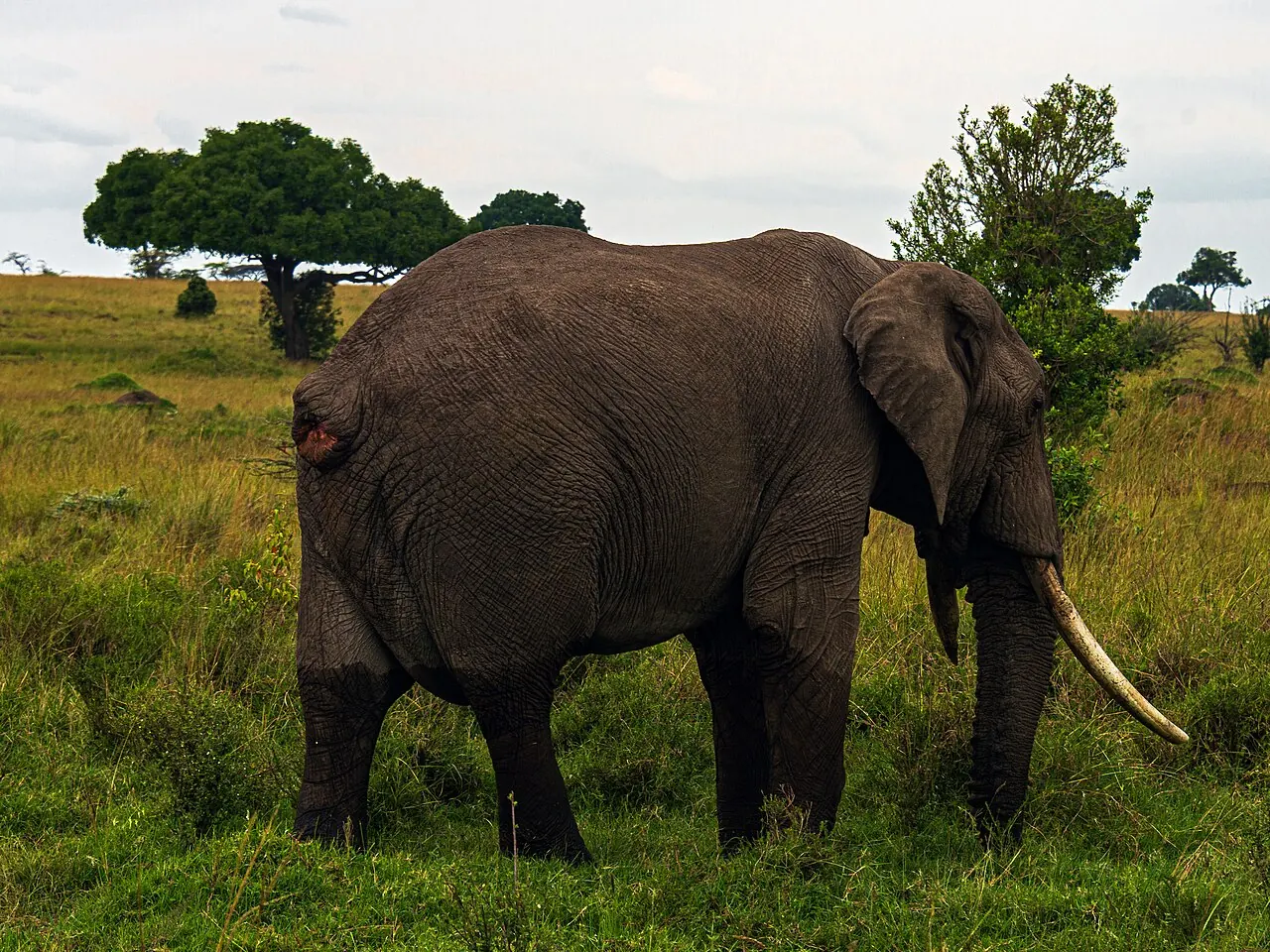
Photo: Daniel Case / Wikimedia Commons, CC BY-SA 4.0
How much compensation does Kenya pay for wildlife attacks?
Under section 25 of the Wildlife Act: KSh 5 million for a death, KSh 3 million for an injury causing permanent disability and up to KSh 2 million for other injuries. Crop, livestock and property losses are paid at market rates.6
Death and injury: elephant, lion, leopard, rhino, hyena, crocodile, cheetah, buffalo, hippo and wild dog. Crop, livestock and property: the same plus zebra, eland, wildebeest and snakes6.
Report the incident to the nearest KWS office; the County Wildlife Conservation and Compensation Committee verifies the claim and recommends payment. If you disagree with the decision you can appeal to the National Environment Tribunal within 30 days, then to the Environment and Land Court6.
How long do wildlife compensation claims take?
Years. In November 2025 the Wildlife Principal Secretary told Parliament more than 20,000 claims were pending, some since 2014, and that payment of 2021–2023 claims had not yet started.8
KWS paid KSh 3.08 billion between 2017 and 2021, far less than claimed8. County committees have often stopped meeting without allowances, and the ministry has floated lowering the KSh 5 million death payment8. A digital scheme with standard payouts, requiring proof of a protective measure, is being introduced9. Narok’s new conservancies law includes support for families harmed by wildlife1011.
Parliament's Public Accounts Committee (2025)
National compensation is a legal right but chronically underfunded and slow; MPs accused the ministry of failing victims and questioned spending KSh 800 million on a digital system.8
Wildlife Principal Secretary (2025)
The KSh 5 million death payment may need to be revised downward to align with insurance benchmarks and fiscal limits.8
Do Mara conservancies pay for livestock killed by predators?
Some do, through consolation schemes. Mara North has run one since 2016, funded by members and tourism partners, with GPS-photo verification and a quarterly committee. Siana has a conflict fund, and the Mara Conservancy pays consolation for livestock killed by wildlife.11213
Local schemes pay less than the law promises but they pay faster, and Mara North’s is credited with reducing retaliatory attacks on predators1. MMWCA lists consolation schemes as a benefit in some conservancies14. Ask your conservancy whether it has one and how to claim.
What protects cattle and crops from wildlife?
Strong bomas, lights and early warning. The Anne K. Taylor Fund reports about 800 fortified bomas in the Mara by 2018, 99% successful against predators; Kenya Wildlife Trust’s predator bomas recorded no losses where installed.1516
Predator-proof bomas
Lion lights
Collars and alerts
- Collared lions and cheetahs send geofence alerts
- 2,354 alerts in 2024 used to warn herders17
Drones for elephants
What should I do after wildlife kills livestock or destroys crops?
Report it quickly, record it, and never retaliate.
- Keep everyone safeMove people and livestock away; call conservancy rangers or KWS if the animal is still near.
- Report the same dayTo the conservancy office, the nearest KWS station and your chief. Note the date, time, place and animal.
- Record the lossPhotographs with location, witnesses, the ear tag or brand of the animal, receipts for crops.
- ClaimThrough the conservancy’s consolation scheme if there is one, and through KWS for statutory compensation.
- Do not poison or spearRetaliation kills lions, vultures and dogs, is a crime, and ends any compensation claim.
If claims in your area go unanswered, raise it at a baraza; we will take collected cases to the county committee.
Questions about living with wildlife
How much compensation does Kenya pay for a death caused by wildlife?
KSh 5 million under section 25 of the Wildlife Conservation and Management Act; KSh 3 million for permanent disability and up to KSh 2 million for other injuries.6
How long do wildlife compensation claims take in Kenya?
Years in many cases: in November 2025 over 20,000 claims were pending, some from 2014, and payments for 2021-2023 had not started.8
What is a predator-proof boma?
Do Mara conservancies pay for livestock killed by predators?
Is elephant crop raiding increasing around the Mara?
Yes, by Mara Elephant Project records: conflict incidents rose from 84 in 2016 to 452 in 2025, driven by expanding farms and fencing.2
Sources for this page
- National human-wildlife conflict assessment for Kenya (FAOLEX record ken233832) · Government of Kenya document via FAOLEX (exact title not captured) · 2024
- Conflict · Mara Elephant Project · 2026-03-06
- MPCP Q3 2025 Report · Mara Predator Conservation Programme · 2025-11-12
- Predator-Proof Bomas – A new dimension in human-wildlife conflict resolution · Nature Kenya · 2021-01-06
- Human-Wildlife Conflicts, Household Livelihood Security, and Conservation Support Among Residents Adjacent to the Maasai Mara National Reserve · Wild (MDPI) · 2025-02-27
- Wildlife Conservation and Management Act, Cap. 376 (No. 47 of 2013), as at 4 November 2025 · Kenya Law · 2025-11-04
- Wildlife Conservation and Management (Compensation) Regulations, Legal Notice 245 of 2017 · Kenya Law · 2017 (rev. 2022)
- Kenya: MPs Decry Delays in Human-Wildlife Conflict Payouts As Thousands Await Justice · Capital FM via allAfrica · 2025-11-07
- Leveraging insurance-based methods and enhanced compensation to support human-wildlife coexistence (review) · ZSL · 2026-10
- Summary of the Narok County Wildlife Conservancies Bill, 2026 · Publisher not stated on document (Narok County bill summary) · 2026
- Narok County Annual Development Plan FY 2025-26 · County Government of Narok · 2025
- Mara Conservancies (member conservancy profiles) · MMWCA · read 2026-11-22
- Mara Conservancy homepage (conservation and HWC measures) · Mara Conservancy · read 2026-11-22
- MMWCA homepage (headline statistics) · MMWCA · read 2026-11-22
- Predator-Resistant Bomas · Anne K. Taylor Fund · read 2026-11-22
- Recycled plastic poles bomas protecting livestock in the Mara · Kenya Wildlife Trust · 2020
- Kenya Wildlife Trust 2024 Annual Report · Kenya Wildlife Trust · 2025-05-21
- Kenya Wildlife Trust 2025 Annual Report · Kenya Wildlife Trust · 2026-06-17
- MEP May 2026 External Report · Mara Elephant Project · 2026-06-09
- MEP September 2026 External Report · Mara Elephant Project · 2026-10-14
Sources checked 22 November 2026.
What we could not confirm (4)
- Narok-specific (county committee) compensation claim and payment figures were not found.
- Rates paid by Mara North, Siana or Mara Conservancy consolation schemes were not published in sources read.
- Lion Guardians operates mainly outside the Mara (Amboseli/Mbirikani); no Mara programme was verified.
- Mukeka et al. 2019 was not read directly; its figures come via a national HWC assessment on FAOLEX whose exact title was not captured.
Bring it to a baraza
Landowners, leaseholders, residents, camps and conservancy managers: a baraza is where questions about leases, grazing, corridors and wildlife get answered in the open, in Maa, Kiswahili or English. Ask us to help organise one in your village.