
Can Maasai herders graze cattle in Mara conservancies?
Yes, but under rules. Grazing is usually restricted around tourist camps, allowed in rotation further away, permitted by day only, and loosened in the low season or severe drought. Sheep and goats are usually not allowed in.1
Some conservancies run a single large herd and open parts of the land in succession, admitting neighbouring herds on rotation1. Mara North has four zonal grazing committees under its landowners’ committee2. Olare Motorogi landowners agreed to move their homes and allow only carefully managed grazing3. Rangers enforce the rules: herds caught outside permitted times or places are impounded until a fine is paid1. Each conservancy profile lists that conservancy’s own grazing rules where they are published.
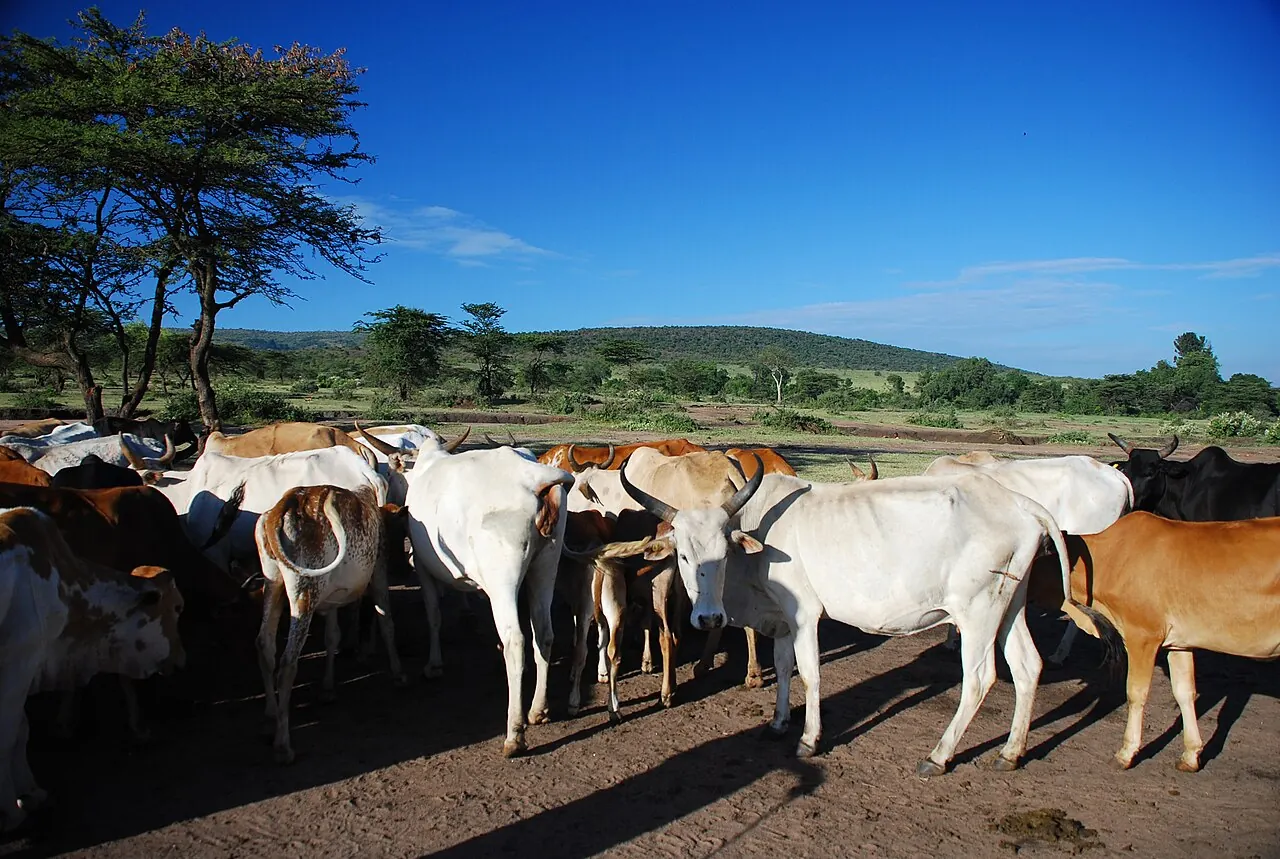
Photo: imaginextra / Wikimedia Commons, CC BY 2.0
Why do conservancies restrict grazing?
The reason most often given is that tourism investors do not want cattle near their camps. Where grazing was first banned outright, investors had to be persuaded to allow some.1
There is an ecological case too: rested grass holds more wildlife and stores more soil carbon, and both overgrazing and undergrazing reduce it4. Pressure on the Reserve has grown: aerial surveys found cattle incursions rose by over 1,000% between 1977 and 20165, and across Kenya’s rangelands livestock now outweigh wildlife about eight to one6.
Key informants in Bedelian & Ogutu 2017
Tourism investors drove livestock exclusion; integrating cattle would need investors and marketing to change.1
Do grazing rules hurt Maasai households?
They carry real costs. Herders complain that conservancies cut the grazing available and block salt licks, water and the olkeri kept for sick, old and young stock, and that lease payments do not cover animals lost in drought.1
In a 2010 survey, 87% of Koiyaki households grazed inside conservancies, some outside agreed times, and 66% grazed in the Reserve, mostly at night to avoid fines1. Lease payments were 21% of member households’ income, while livestock were 48% for members and 70% for non-members1. Herds were also shrinking: a third of households were below the level needed for a purely pastoral life1.
Chart © MaraConservation.org from the cited sources.
Other studies are mixed. One found households that leased land had lower incomes and more predation and crop losses than non-members7; another found perceived gains in income and services alongside elite capture and uneven benefits8.
What is a grass bank, and how do conservancies help herders?
A grass bank is grazing kept in reserve for the dry season and drought. Households rate conservancy land higher than other land for grass, water and salt licks, and value it most when the rains fail.1
Pardamat keeps grass banks for dry-season grazing9, and MMWCA counts grass access among conservancy benefits10. During the 2008–09 drought the Olare Orok payments were the most equitable income households had, but they widened the gap between paid and unpaid households11. Maasai near the Reserve keep strong preferences for livestock, stronger among conservancy members than non-members12.
Can cattle and wildlife be managed together?
Enonkishu shows they can. Its landowners named it “a place of cattle”, put livestock at the core of the conservancy, and recorded vegetation quality 24% higher in planned grazing blocks than outside, 2017–2022.13
Planned grazing, grazing an area and then resting it, is a centuries-old pastoral practice4. Conservation International has funded a regenerative grazing plan in Naboisho and livestock enterprise plans in Mara North14, and the One Mara Carbon Project aims to earn income from better grazing across the conservancies. See Enonkishu.
How could grazing rules better respect pastoral life?
By making the rules with the people who herd. Researchers recommend participatory grazing plans that include women, herders and non-members living beside conservancies, plans that extend beyond conservancy boundaries, and telling tourists to expect livestock.1
- Make rules in the openGrazing plans agreed at barazas with herders, women and neighbours, not announced from an office.
- Keep the essentials openWater points, salt licks, livestock routes and the olkeri for weak stock should stay reachable.
- Plan for droughtClear, agreed triggers for opening grass banks before animals start dying.
- Fair enforcementPublished fines, a receipt for every impounded herd and a way to appeal.
- Change the story for visitorsCattle are part of the Mara; camps can say so instead of hiding them.
Bring your grazing questions to a baraza, and read about Maasai pastoralism and conservation.
Questions about grazing in the conservancies
Can Maasai herders graze cattle in Mara conservancies?
What is a grass bank in the Mara?
Do conservancies make Maasai households better off?
What is holistic planned grazing at Enonkishu?
Enonkishu manages cattle in planned grazing blocks; monitoring from 2017 to 2022 found these blocks about 24% higher in vegetation quality than comparable land outside.13
How could conservancy grazing rules better respect pastoral life?
Researchers recommend grazing plans drawn up with women, herders and non-members, extending beyond conservancy boundaries, recognising salt licks, water and olkeri reserves, and telling tourists to expect livestock.1
Sources for this page
- Trade-offs for climate-resilient pastoral livelihoods in wildlife conservancies in the Mara ecosystem, Kenya (Bedelian & Ogutu) · Pastoralism: Research, Policy and Practice · 2017-05-23
- An Analysis of Non-State Protected Area Governance in Kenya · IUCN PAPACO · c. 2017
- Mara Conservancies (member conservancy profiles) · MMWCA · read 2026-11-22
- The carbon market: a new opportunity for Maasai Mara conservancies · LGT Impact Fellowship · 2022-08-08
- People are taking a huge toll on the plains of the Serengeti-Mara · The Conversation · 2019-04-01
- Extreme Wildlife Declines and Concurrent Increase in Livestock Numbers in Kenya: What Are the Causes? (Ogutu et al.) · PLOS ONE · 2016-09-27
- Effects of protected areas on welfare of local households: The case of Maasai Mara National Reserve (Mojo et al.) · People and Nature (BES) · 2020-09
- Livelihood impacts and governance processes of community-based wildlife conservation in Maasai Mara ecosystem, Kenya (Oduor) · Journal of Environmental Management · 2020-04-15
- A Space Where People and Wildlife Thrive (Pardamat Conservation Area) · The Nature Conservancy · 2025-12-01
- MMWCA homepage (headline statistics) · MMWCA · read 2026-11-22
- Why keep lions instead of livestock? Assessing wildlife-tourism based payment for ecosystem services involving herders in the Maasai Mara (Osano et al.) · Natural Resources Forum (record at ILRI CGSpace) · 2013-11
- Gender Differentiated Preferences for a Community-Based Conservation Initiative (Keane et al.) · PLOS ONE · 2016-03-29
- Bridging the conservation and development trade-off? A working landscape critique of a conservancy in the Maasai Mara (Tyrrell et al.) · Ecological Solutions and Evidence (BES) · 2024-07
- African Conservancies Facility · Conservation International (CI Ventures) · read 2026-11-22
- What Drives Compliance with Rules in Community-Based Conservation? Lessons from Maasai Mara, Kenya · Environmental Management (Springer) · 2025-12-10
- Evaluating the determinants of participation in conservancy land leases and its impacts on household wealth in the Maasai Mara (Bedelian, Ogutu, Homewood & Keane) · World Development 174 · 2024-02
Sources checked 22 November 2026.
What we could not confirm (3)
- Keane et al. 2020 on the Mara was not located; Keane et al. 2016 (PLOS ONE) and Bedelian, Ogutu, Homewood & Keane 2024 (World Development) were used instead.
- Current written grazing plans for individual conservancies (zones, seasons, fines) were not found as public documents.
- No quantitative data on fines collected for illegal grazing were found.
Bring it to a baraza
Landowners, leaseholders, residents, camps and conservancy managers: a baraza is where questions about leases, grazing, corridors and wildlife get answered in the open, in Maa, Kiswahili or English. Ask us to help organise one in your village.