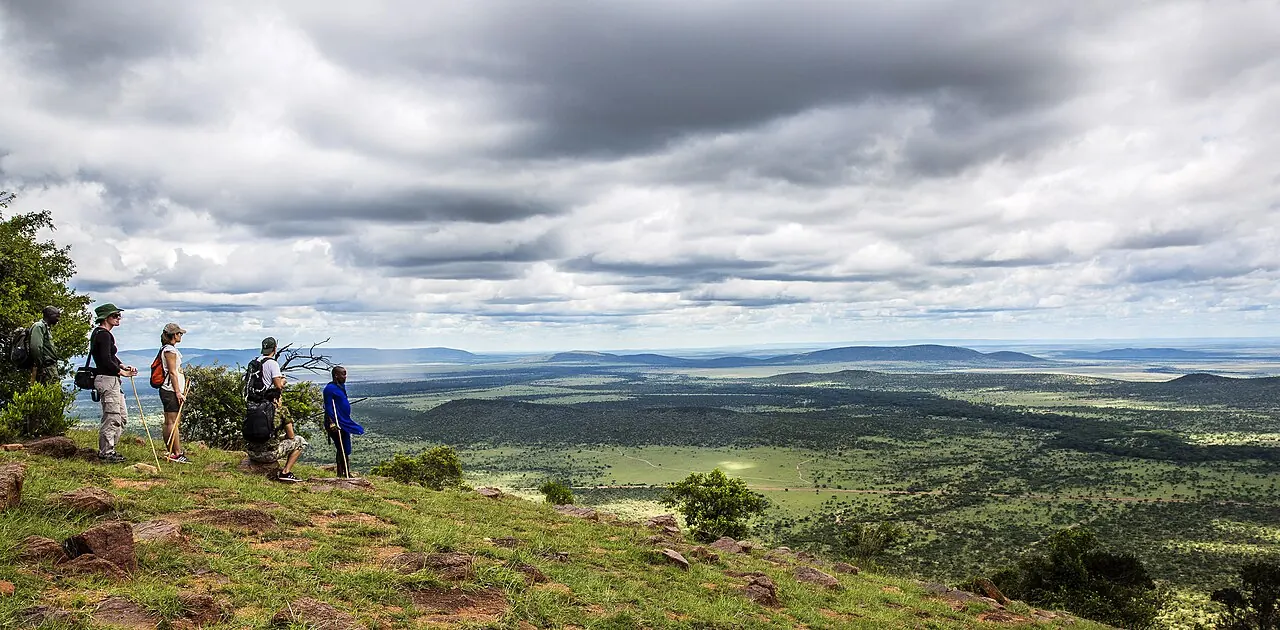

What is Loita Hills Community & Wildlife Conservancy?
Loita Hills Community & Wildlife Conservancy is a 2,500-ha developing conservancy at the foot of the Loita Hills around Maji Moto village, set up in 2023 with 141 landowners. Its single tourism partner is Loita Hills Basecamp.
- Developingstatus, 2025 map
- 2023started
- 25 km²published area
- 141landowners
- Registered as a trust, according to MMWCA.1
- Listed on the MMWCA 2025 ecosystem map as entry 20, type 'Conservation Area', status 'Developing'.2
- Listed by KWCA as 'Loita Hills Conservancy', region Mara, Narok County, regional association MMWCA (KWCA member list read 20 Nov 2026).3
Also written: Loita Hills Community and Wildlife Conservancy, LHCWC, Loita Hills Conservancy, Loita Community Wildlife Conservancy, Loita Conservancy.
Where is Loita Hills?
At the foot of the Loita Hills, around Maji Moto village, in the Mara region of Narok County. Its one tourism partner, Loita Hills Basecamp, gives its address as 'Maji Moto village (Chief Sankale's Camp) Loita Hills'. The coordinates are those of the Basecamp, inside the conservancy, not a surveyed centre.45
- Loita Hills Basecamp offers transfers and day safari trips to the Masai Mara Reserve.4
Who owns and runs Loita Hills?
What wildlife lives in Loita Hills, and what is its corridor role?
Wildlife in Loita Hills
- MMWCA calls the Loita Hills a vital migratory route, particularly for elephants, and a crucial elephant maternity zone.1
- Diverse acacia species provide food for elephants and giraffes.1
- Context: the nearby Loita (Naimina Enkiyio) Forest elephant population was estimated at 441 in 2018 and appeared resident; IFAW gives about 430.67
Migration corridor in Loita Hills
- MMWCA describes Loita as 'the second conservancy with the highest number of elephant corridors'.1
- Mara Elephant Project (2016) mapped an elephant route joining the Naimina Enkiyio Forest and the Loita Hills around Oln'garua, then in the process of land subdivision, and flagged connectivity to the Mara via the Loita Hills and/or Maji Moto as needing study.8
- The Greater Maasai Mara Ecosystem Management Plan 2023-32 names the Loita Hills and Naimina Enkiyio Forest among ecologically critical outlying areas needing a different conservation model.9
Why corridors matter for the whole Mara: opening the migration corridors.
Which camps are in Loita Hills?
What can visitors do in Loita Hills, and what does it cost?
- nature hikes
- walking safaris
- cycling tours (MTB)
- game drives
- hilltop campsite
- Maasai village visit
- wildlife patrol with rangers
- bush expeditions
- natural hot spring
- day trips to the Masai Mara reserve
How conservancy fees compare with Reserve entry: Mara conservancy fees and visitor rules.
How does Loita Hills support its community?
What challenges does Loita Hills face?
- Context: a CGIAR field visit (Oct-Nov 2024) found the Loita Hills moving from communal to individual land ownership; MMWCA and KWCA had met communities to explore conservancies, and locals stressed the need for long discussion and careful mobilisation.10
- Context: IFAW (2025) reports land subdivision threatens the community-managed Loita Forest.7
We report what sources say, from every side. Claims made by one party are reported as claims, not as findings; only a court decides who is right, and interim court orders are not final decisions. If you are named here and want your response added, or think something is wrong, write to hello@maraconservation.org and we will review it within 14 days. If you live with one of these issues, a baraza is where it can be raised and recorded.
History of Loita Hills
Where do sources disagree about Loita Hills?
Questions about Loita Hills
Where is Loita Hills Conservancy?
Is Loita Hills Conservancy the same as the Loita Forest?
Where can you stay in Loita Hills Conservancy?
MMWCA names one tourism partner, Loita Hills Basecamp, with a main camp inside the conservancy and a campsite on top of the hills.1
What can you do in Loita Hills Conservancy?
MMWCA lists nature hikes, walking safaris, cycling tours and game drives, plus a natural hot spring.1
Are there elephants in the Loita Hills?
Who founded Loita Hills Community and Wildlife Conservancy?
MMWCA says Sankale Ntutu and Manon Van Oldenvarneveld established it in 2023 as a trust.1
Sources for this profile
- MMWCA member page: Loita Hills Community and Wildlife Conservancy · MMWCA
- Masai Mara Ecosystem 2025 map (Ecosystem-Map-2026.pdf) · MMWCA / WRTI · 2025
- KWCA member conservancies (WP REST wp/v2/conservancy) · KWCA
- Loita Hills Basecamp · Loita Hills Basecamp
- Google Maps listing: Loita Hills Basecamp – Maji Moto (coordinates) · Google Maps · 2026-11-04
- National Elephant Action Plan for Kenya 2023-2032 · KWS / Ministry of Tourism and Wildlife · 2023
- Land subdivision threatens the survival of critical Maasai community forest in Kenya · IFAW · 2025-08-06
- Mara elephants and ecosystem connectivity (April 2016) · Mara Elephant Project · 2016-04
- Greater Maasai Mara Ecosystem Management Plan 2023-32 · County Government of Narok, MMWCA, KWS, WRTI · 2023-02
- Field Trip Report: Loita Hills, Narok (30 Oct – 1 Nov 2024) · CGIAR (C. Bedelian, A. Notenbaert) · 2024
What we could not confirm (6)
- Ward and sub-county not confirmed for the conservancy itself (the CGIAR report places Loita Division in Narok South Sub-county, but does not mention this conservancy).
- Bordering conservancies or reserve not published.
- No conservancy website found; lease terms, payments, visitor rules, fees and bed numbers not published.
- The hot spring's location and the hilltop campsite's capacity not published.
- No Commons photograph that names the conservancy; only a general Loita plains and hills view.
- No relation found in sources between this conservancy and the emerging Loita-area entries on the 2025 map (Entasekera, Morijo Olng'arua, Olmesutie, Olorte, Ilkerin).
Researched 22 November 2026. Corrections from Loita Hills landowners, managers and residents are welcome: contact us.
Bring it to a baraza
Landowners, leaseholders, residents, camps and conservancy managers: a baraza is where questions about leases, grazing, corridors and wildlife get answered in the open, in Maa, Kiswahili or English. Ask us to help organise one in your village.